
Why Reclaimed Building Materials Are Becoming More Important in the UK Circular Economy
2026-09-02
Why Reclaimed Building Materials Are Becoming More Important in the UK Circular Economy
Construction has traditionally followed a largely linear model: extract, manufacture, install, use and remove. A circular economy asks whether useful materials can stay in circulation for longer — and that could make reclamation increasingly important.
For much of modern construction, materials have followed a relatively simple path.
They are extracted, manufactured, installed, used and eventually removed when a building is refurbished or demolished.
Too often, that final stage has meant valuable materials being crushed, downcycled or discarded even when some of them could potentially have remained useful.
The idea of a circular economy challenges that model.
Instead of treating building materials as disposable, circular construction asks how they can remain in use for longer, retain more of their value and move from one project into another.
What does a circular economy mean for construction?
A circular economy aims to reduce unnecessary resource consumption by keeping materials and products in use for as long as practical.
In construction, that can involve repairing existing buildings, designing for adaptability, recovering materials during redevelopment, reusing products and recycling materials that can no longer be used in their original form.
The important distinction is that circularity is not simply another word for recycling.
Materials move through a project once before becoming waste or lower-value material.
Products are kept useful for longer and moved into future projects where practical.
Recycling can be valuable, but it often involves breaking a product down and processing the resulting material into something else.
Reuse attempts to preserve more of the original product.
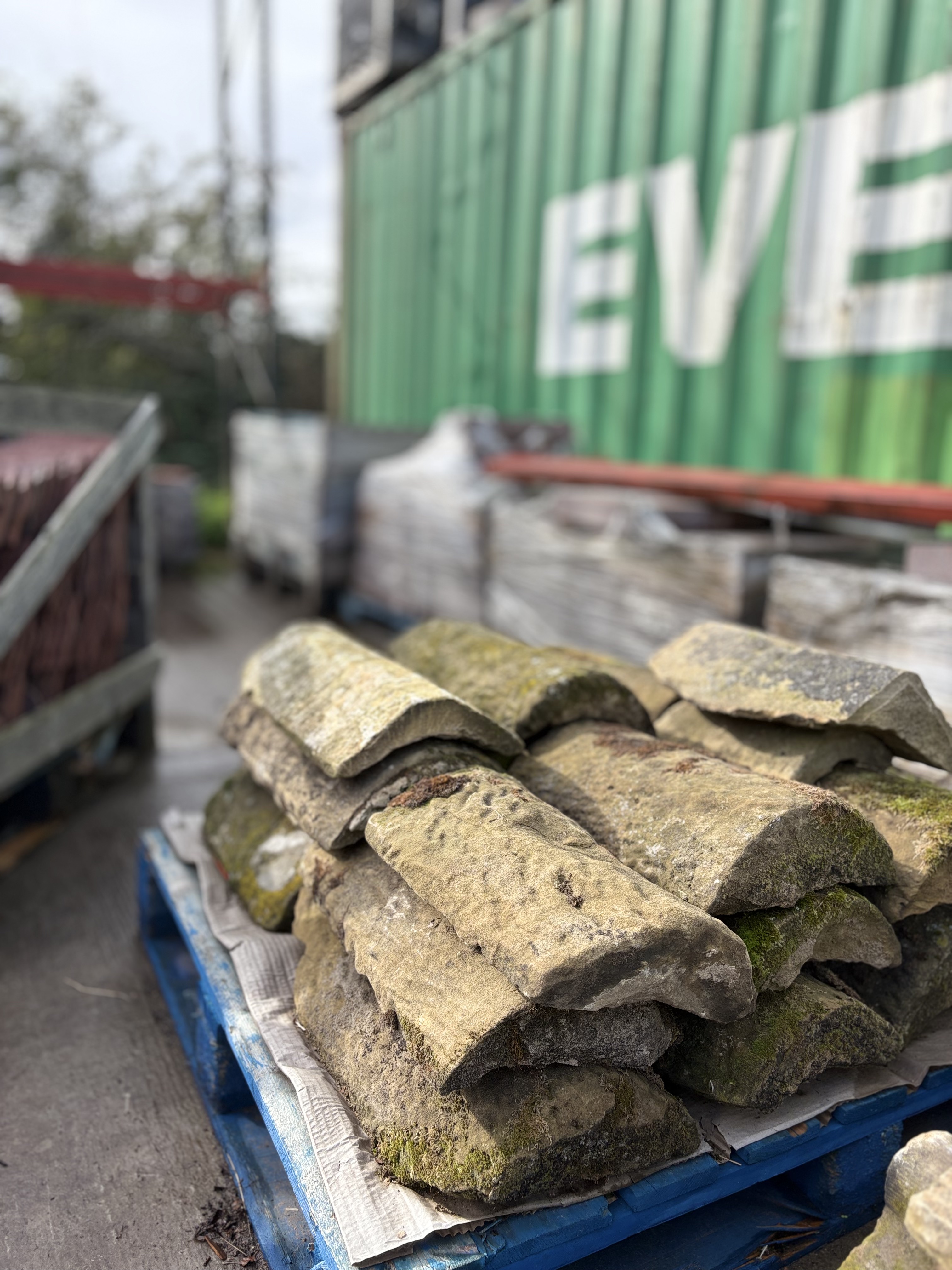
A reclaimed brick remains a brick. A roof slate can remain a roof slate. A timber beam may remain a beam. A stone paving slab may be lifted from one project and laid again elsewhere.
That ability to preserve finished products is one of the reasons architectural reclamation fits so naturally within a circular construction economy.
Construction uses an enormous quantity of resources
The scale of the construction industry means even relatively small improvements in material recovery can matter.
The UK Green Building Council has highlighted the scale associated with construction, demolition and excavation.
Buildings contain huge quantities of timber, bricks, stone, tiles, metals, sanitaryware, flooring and architectural components.
When a building reaches the end of one use, those materials do not automatically reach the end of their useful lives.
The challenge is recovering them in a condition that allows another project to use them.
Waste can sometimes be viewed as future stock
A circular approach changes the way demolition and refurbishment materials are viewed.
Instead of asking only how waste will be removed from a site, project teams can ask whether valuable materials can be identified before work begins.
That is the thinking behind concepts such as pre-demolition audits and buildings as material banks.
The figures demonstrate the scale of material that can exist inside a single redevelopment project.
They also show why identifying materials before demolition can create opportunities that may disappear once everything has been mixed together.
Reuse sits higher up the value chain
Not all forms of material recovery preserve the same amount of value.
Consider an old brick wall.
The bricks could be carefully removed, cleaned and reused as bricks.
Alternatively, they could be crushed and used as aggregate.
Both approaches may be preferable to landfill, but the first retains the manufactured product itself.
The original product remains in use.
The product is processed into another material.
Remaining material value may be lost.
Where direct reuse is practical:
- Timber beams can potentially remain structural or decorative timber.
- Roofing slates can potentially return to another roof.
- Stone paving can potentially be lifted and relaid.
- Doors, fireplaces and architectural features can potentially be installed again.
- Bricks can potentially be cleaned and incorporated into new or repaired masonry.
Where direct reuse is practical, more of the original manufacturing, workmanship and material value can remain intact.
Material prices strengthen the case for using existing resources
Environmental pressure is not the only reason reclaimed materials may become more important.
The cost and availability of new construction materials also matter.
When new material prices rise or supply becomes less predictable, existing stock becomes more economically interesting.
That does not mean reclaimed products will always be cheaper than new alternatives.
Recovery, cleaning, sorting, storage and transport all create costs.
But a more resilient materials market may increasingly involve both newly manufactured products and secondary materials already circulating within the economy.
Some traditional materials are becoming harder to replace
Circularity is also particularly relevant to Britain's historic building stock.
Historic England has emphasised the importance of using appropriate and compatible materials when repairing traditional buildings.
Traditional materials can vary significantly between regions, reflecting local geology, manufacturing techniques and building traditions.
Some sources of traditional stone and other historic materials have also become difficult to access.
In these circumstances, reclaimed stock is not simply a sustainability choice. It can be one of the most practical ways of finding a material that genuinely matches an existing building.
Deconstruction can recover more than demolition
For a stronger secondary-materials economy to develop, useful products need to survive the end of their first building.
That makes the way structures are dismantled increasingly important.
Fast demolition may be appropriate in some circumstances, but it can make direct reuse more difficult when materials become broken, contaminated or mixed.
Deconstruction takes a more selective approach.
Materials are identified and removed with their future value in mind rather than being treated immediately as mixed waste.
The more carefully materials are recovered, the greater the opportunity to move them back into useful circulation.
The reclamation yard becomes part of the circular supply chain
Once materials leave a building, they need somewhere to go.
This is where reclamation yards perform an important function.
They can provide the link between the building that no longer needs a material and the project that does.
- Recovering materials
- Transporting stock
- Cleaning and preparation
- Sorting by type and condition
- Storing materials until a buyer is found
- Identifying unusual or historic products
- Matching materials to existing buildings
- Connecting recovered stock with new projects
In a circular economy, those activities are not simply salvage operations.
They are part of the infrastructure required to keep construction materials circulating.
Secondary-material markets are developing
The UK Green Building Council has identified growing interest in secondary-material marketplaces and reuse hubs.
The principle is straightforward.
One organisation may have surplus or recovered material while another project is actively trying to source it.
Historically, connecting those two sides of the market could be difficult.
Demolition projects, surplus stock, reclamation yards and refurbishment.
Architects, builders, roofers, restorers, developers and homeowners.
Digital platforms have the potential to make those connections much easier.
Instead of reusable materials being limited to customers who happen to visit a local yard, detailed online stock can potentially reach buyers across a much wider area.
Information is becoming part of the material's value
A circular materials market cannot operate efficiently if nobody knows what is available.
This is one of the biggest opportunities for the reclaimed sector.
A physical material may have substantial value, but that value becomes harder to realise if buyers cannot establish its dimensions, condition, quantity or location.
A useful reclaimed-material record can include:
The future value of reclaimed materials may depend increasingly on good data as well as good stock.
Traceability could become increasingly important
The direction of UK construction-product reform also points towards greater emphasis on information and traceability.
Government proposals have explored issues including reuse, circularity, environmental information, digitalisation and stronger product records.
Reclaimed materials present a particular challenge because their original documentation may have disappeared decades ago.
But they also create an opportunity.
Record what the material actually measures.
Document wear, weathering and defects.
Preserve a visual record of the stock.
Retain known history where it can be supported.
That could make reclaimed materials easier to assess and specify in professional projects.
Circularity does not mean everything should be reused
A credible circular economy also needs to recognise the limits of reuse.
Not every reclaimed product will be suitable for another project.
- Materials may be damaged.
- Some may be contaminated.
- Weathering may make some stock unsuitable.
- Performance requirements still need to be met.
- Structural products may require grading, testing or professional assessment.
The goal is therefore not to force every old product back into use.
It is to avoid discarding materials that still have genuine value simply because systems for identifying, recovering and selling them are underdeveloped.
Demand is changing as well as supply
The reclaimed-materials market is also benefiting from changing design preferences.
Recent UK interiors research has shown growing search interest in natural stone, stone walls, dark woods, traditional interiors and period-inspired design.
This creates an interesting overlap.
Existing buildings may require materials with the right size, appearance, age and compatibility.
Customers may deliberately choose aged materials for texture, patina, individuality and history.
Materials that support a more circular construction economy can also provide qualities that many homeowners and designers actively want: texture, patina, age, regional character and individuality.
A stronger circular market needs better connections
The physical supply of reclaimed materials already exists across Britain.
It can be found in buildings awaiting refurbishment, demolition sites, reclamation yards, surplus stock and materials already removed from previous projects.
The challenge is connecting that supply with demand at the right time.
A contractor may have hundreds of suitable bricks available while a restoration project elsewhere is actively searching for the same type. If they cannot find one another, the opportunity for direct reuse may disappear.
Better marketplaces, stock records and logistics could therefore be just as important to circular construction as the materials themselves.
From salvage industry to secondary-materials economy
Architectural reclamation has existed in Britain for generations.
What is changing is the wider context around it.
These pressures and opportunities are beginning to overlap.
That creates the possibility of reclamation becoming more than a specialist market for unusual architectural pieces.
It can become part of a broader secondary-materials economy in which useful building products routinely move from one project to another.
Before manufacturing another material, ask whether a suitable one is already available
The central idea behind circular construction is remarkably simple.
Before extracting, manufacturing and transporting another material, ask whether a suitable one is already available.
In many cases, the answer will still be no.
New materials will remain essential to British construction.
But where usable bricks, timber, stone, tiles, slates and architectural materials already exist, recovering and circulating them can preserve resources, retain economic value and reduce unnecessary waste.
As the UK moves towards a more circular approach to construction, the ability to find, understand and reuse those existing materials could make the reclamation industry increasingly important.
Have reclaimed building materials to sell?
Materials from demolition, renovation or surplus stock could have value in another project.
Sell Reclaimed Materials →