
Where Did Your Building Materials Come From? Why Provenance Is Becoming More Valuable
2026-09-02
Where Did Your Building Materials Come From? Why Provenance Is Becoming More Valuable
A reclaimed building material is rarely just a physical object. It may also carry evidence of where it was made, who produced it, how it was used and the building it once formed part of.
A reclaimed building material is rarely just a physical object.
It may also carry evidence of where it was made, who produced it, how it was used and the building it once formed part of.
That history is known as provenance.
For homeowners, architects, conservation professionals and designers, provenance can help with identification, matching, specification and understanding the character of a reclaimed material.
For many years, provenance was often treated as an interesting extra within architectural reclamation.
Increasingly, however, information about a material's origin could become much more important.
What does provenance mean for a building material?
Provenance simply refers to the known history or origin of an object or material.
For reclaimed building materials, that information can take many forms.
The structure or site the material was recovered from.
The approximate period in which the material was made or used.
The company or producer responsible for making it.
Stamped names, symbols, lettering or identifying details.
The town, region, clay source, quarry or local industry connected with it.
The role the material performed in its first building.
The date and location where it entered the reclamation process.
Sometimes this history is well documented. In other cases, only fragments survive.
Even incomplete provenance can provide useful clues about what a reclaimed material is and where it belongs.
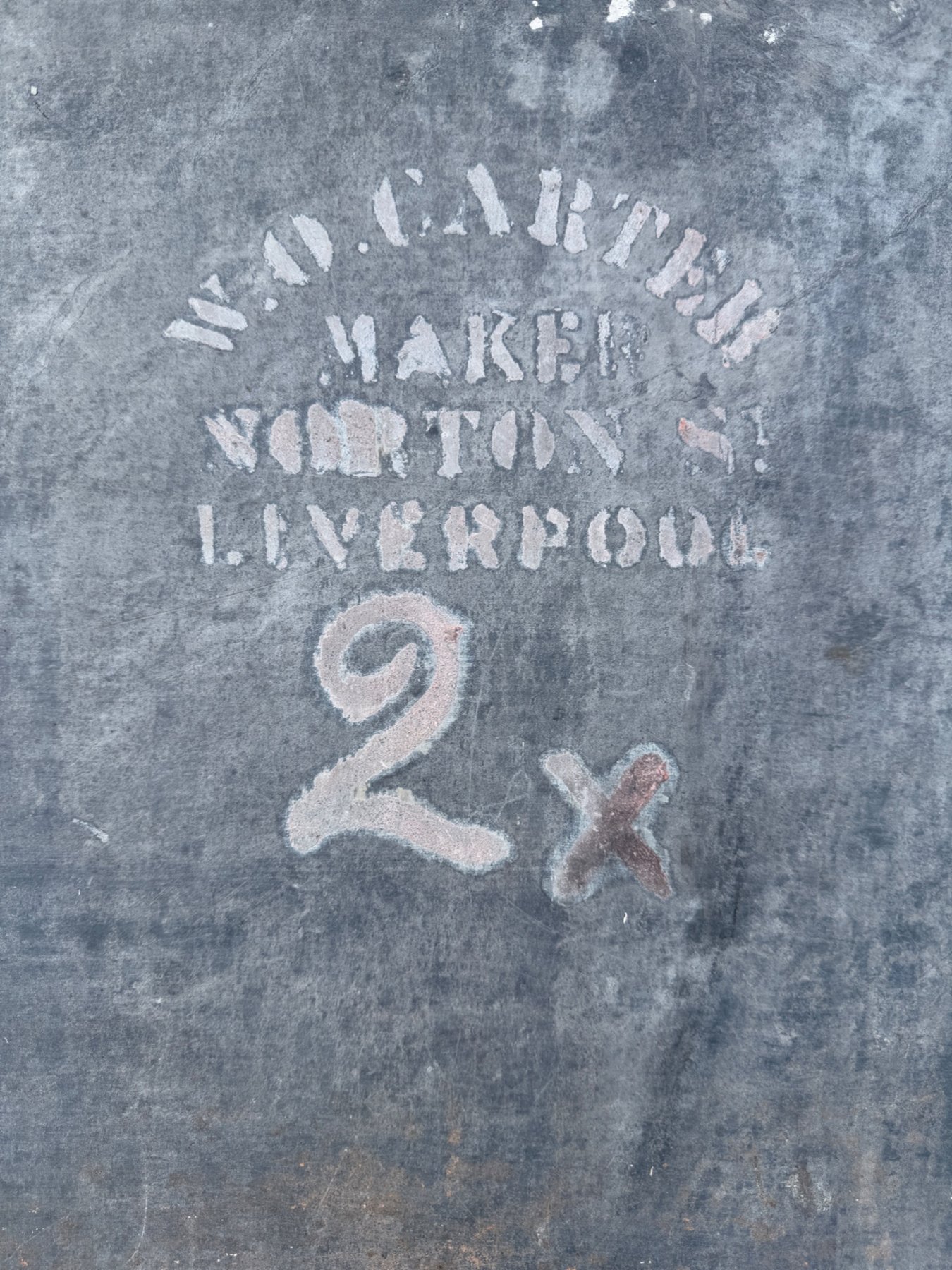
Maker's marks can provide important clues
Some reclaimed materials still carry the marks of the companies that produced them.
Bricks may contain stamped names. Roof tiles can carry manufacturer markings. Cast-iron features, sanitaryware, timber products and other architectural components may include symbols, lettering or production details.
These marks can provide a starting point for identifying where a material came from and approximately when it was produced.
An old manufacturer's name can sometimes be linked to a particular factory, town or period of production.
Even when the exact wording is difficult to identify, a surviving mark is evidence that building materials were produced within real local industries and supply chains.
Britain's buildings were shaped by local materials
The appearance of Britain's historic buildings is closely connected to geography.
Different areas developed distinctive building traditions based partly on the materials that were available locally.
Colour, grain and weathering varied with regional stone sources.
Clay deposits and firing methods influenced colour, texture and form.
Clay tiles, slate and traditional stone roofing reflected local supply.
Historic England has highlighted the importance of locally sourced and appropriate traditional materials in maintaining the character of historic buildings.
Provenance can help explain not only where a material came from, but why a particular town, village or building looks the way it does.
Provenance can help when matching old buildings
Knowing where a reclaimed material came from can also have practical value.
Imagine a builder trying to repair a wall constructed using a distinctive regional brick.
The brick looks close in colour, size and texture.
The batch may also be linked to the same maker, area or production period.
The same principle can apply to stone, slate, tiles and architectural features.
Dimensions, condition, compatibility and suitability still need to be checked carefully.
Buildings themselves have stories
Provenance is not limited to the manufacturer of a material.
Sometimes the most interesting information concerns the building it came from.
A structural material connected with a specific industrial building.
Material carrying a direct connection with transport history and place.
A common material that still forms part of Britain's built history.
That history can give reclaimed material a connection with a specific place and period.
For some buyers, the appeal comes from knowing that the material genuinely formed part of Britain's built environment before entering its next project.
History can add interest, but it must be accurate
The value of provenance depends on trust.
A reclaimed product should not be given a more impressive history simply because that makes it easier to sell.
If the original building, manufacturer or date is uncertain, that uncertainty should be made clear.
Supported by recovery records, surviving marks, photographs or reliable documentation.
The material's characteristics suggest a period, region or manufacturer but do not prove it.
The lack of provenance should be stated rather than replaced with speculation.
Good provenance distinguishes clearly between what is known, what is documented and what is only believed to be likely.
Why information can disappear so easily
One of the challenges facing the reclamation industry is that information can be lost long before a material reaches its next buyer.
A contractor may remove several pallets of bricks from a demolition site.
A batch may remain perfectly usable for decades, while the connection with its original building, maker or place disappears permanently.
This suggests that recording information at the point of recovery could become increasingly important.
What information should be preserved?
Not every reclaimed product requires an extensive historical record, but even basic information can increase its usefulness.
Where the material was removed from.
House, factory, mill, railway building, farm or other structure.
Where a reliable estimate is possible.
Names, stamps, symbols and other identifiers.
Town, region, quarry or production area where known.
How the material functioned in the original building.
How much material was recovered.
Practical data for the material's next use.
Images before and after recovery where available.
This information does not need to make every product historically significant.
Its purpose is to give future buyers a clearer understanding of what the material is and where it came from.
Digital records could change the reclamation market
The growing digitalisation of the construction industry could make provenance much easier to preserve.
Instead of relying on handwritten notes, memory or labels attached to a pallet, reclaimed materials can increasingly be photographed, catalogued and recorded digitally.
That information could travel with the material even after it changes ownership.
Traceability is becoming more important across construction
This development fits within a wider change taking place across the construction-products industry.
Government reform proposals have placed increasing attention on product information, traceability, environmental performance and digitalisation.
Reclaimed materials create a different challenge from newly manufactured products because their history may stretch across decades or even centuries.
But that can also make good information particularly valuable.
The more that is known about a reclaimed material, the easier it can become for professionals to assess whether it may be appropriate for a particular project.
Could provenance increase value?
In some cases, provenance may increase the commercial appeal of reclaimed material.
A buyer may place greater value on an architectural feature with a documented history than on an otherwise similar item with no known origin.
A maker's mark, unusual manufacturer or connection with a particular building can make an item more distinctive.
Condition, scarcity, dimensions, demand and suitability remain important. A fascinating story cannot make an unusable product useful.
The strongest value may come when good material and good information exist together.
From anonymous stock to documented material
The reclamation industry has traditionally been exceptionally good at preserving physical materials.
The next opportunity may be preserving their information as well.
Useful physical material, but little surviving context about where it came from.
Recovery site, manufacturer, age, dimensions, previous use and photographs recorded where known.
For restoration specialists, that could improve matching.
For architects and designers, it could provide greater confidence and context.
For homeowners, it could make the material considerably more interesting.
Reclamation can preserve more than the physical material
The defining characteristic of a reclaimed material is that it has already been used before.
That means every reclaimed brick, beam, tile, piece of stone or architectural feature has a history, even if that history is no longer known.
As the reclaimed-materials market becomes more professional, digital and traceable, preserving more of that information could become an important part of the industry's future.
Reclamation is about saving materials. Provenance gives us an opportunity to save some of their story as well.
Have reclaimed materials with an interesting history?
Quality building materials, architectural features and historic products could have another use ahead of them.
Sell Reclaimed Materials →